5 Social & Content Trends Shaping Marketing Strategies In 2027
AI is making content production faster, short-form video continues to deliver strong results, and social media is becoming increasingly connected to shopping behavior. As we move into 2027, the challenge for brands is no longer simply to produce more content, but to create content that stands out, reaches the right audience, and drives meaningful business results.
Based on market reports and research from HubSpot, Google, McKinsey and other industry sources, five key Social & Content trends are emerging from Q4 2026 through 2027.
1. AI accelerates content production, but human creativity remains the differentiator
AI is becoming an integral part of the content production process. According to a HubSpot survey of more than 1,500 marketers, 83.5% said they are expected to produce more content, while 80% of surveyed marketers use AI for content creation.
However, as more brands gain access to tools that enable faster content production, maintaining a distinctive brand identity is becoming a greater challenge. In fact, 53% of marketers reported difficulties creating differentiated content.
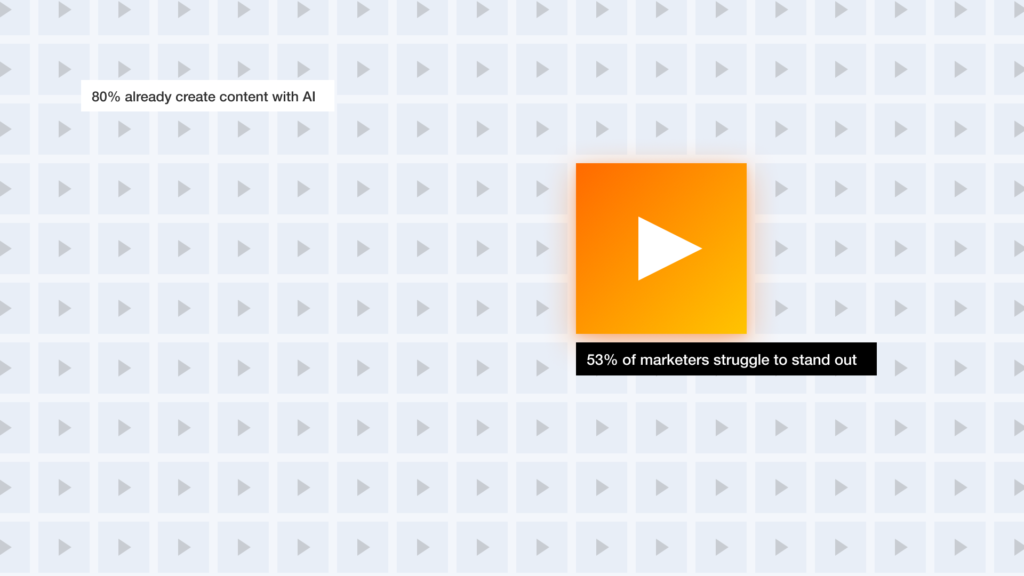
Figure 1. AI makes content faster, but sameness is the risk: 53% of marketers struggle to create differentiated content. Source: HubSpot, 2026 State of Marketing (1,500+ global marketers).
This highlights an important distinction: AI can help brands save time on ideation, copywriting, visual production and content optimization. But relying solely on AI to generate content at scale can result in repetitive messaging and a lack of brand personality.
What should brands do?
- Use AI to support research, brainstorming and content production.
- Establish clear brand guidelines covering tone of voice, messaging and visual identity.
- Keep human input at the center of content review, audience insight development and creative direction.
AI should be a tool that enhances content production, not a replacement for a brand’s unique voice.
2. Short-Form Video Continues to Lead, While Personalization Becomes a Priority
Short-form video remains one of the most effective content formats across social media platforms. According to HubSpot’s 2026 State of Marketing report, 48.6% of marketers identified short-form video as the format delivering the highest ROI, compared with 28.6% for long-form video.
At the same time, AI-powered content personalization is gaining momentum. Around 48.6% of marketers identified it as a key priority in 2026. The survey also found that 93.2% of marketers reported a positive impact from personalization on lead generation and sales.
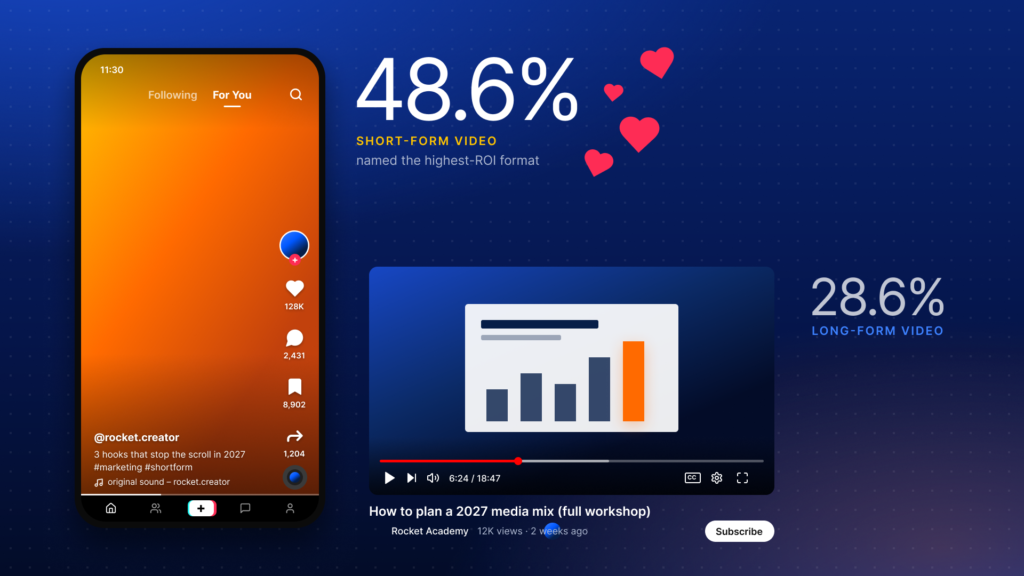
Figure 2. 48.6% of marketers name short-form video as their highest-ROI format, vs 28.6% for long-form. Source: HubSpot, 2026 State of Marketing.
However, personalization is only effective when supported by quality customer data. Without relevant data, even customized content may struggle to address the actual needs of different audience segments.
What should brands do?
- Prioritize short-form video and align each video with a specific objective, whether awareness, consideration or conversion.
- Repurpose core ideas into multiple content variations tailored to different platforms and audience segments.
- Leverage customer data to personalize messaging rather than simply changing the format or presentation.
Instead of focusing solely on video volume, brands should create content that aligns with each touchpoint in the customer journey.
3. Creator marketing shifts from Short-Term campaigns to Long-Term partnerships
Creators are playing an increasingly important role in building trust and influencing purchasing decisions. Unlike conventional advertising, creator-led content often feels more relatable and credible because of the existing relationships creators have built with their communities.
Research cited by Google found that 79% of Gen Z respondents in a US study trust recommendations from YouTube creators. Meanwhile, a Marketing Mix modeling analysis across 20 consumer brands found that long-term creator partnerships generated 2.3 times higher ROAS than paid social.
Repeated collaborations with the same creators can also improve conversion performance. According to data from YouTube and Agentio, advertiser conversion rates doubled between the first and sixth brand integrations with the same creator.
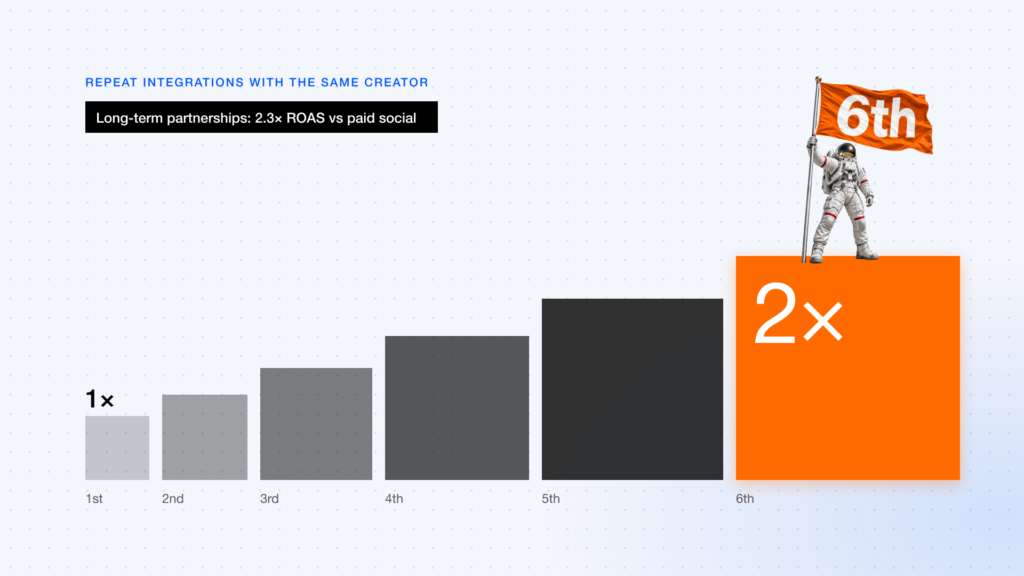
Figure 3. Conversion rates double from the 1st to the 6th integration with the same creator; long-term partnerships deliver 2.3x ROAS vs paid social. Sources: YouTube x Agentio; Think with Google (US data).
These findings suggest that Creator Marketing is not just about generating reach at the time of publication. Its value also comes from building audience trust and familiarity over time.
What should brands do?
- Prioritize creators with relevant expertise, credibility, and audience profiles that align with the brand.
- Shift from one-off campaign collaborations to long-term partnerships.
- Combine micro-influencers with larger creators depending on campaign objectives.
- Measure performance beyond initial views and engagement, including its longer-term impact on conversions.
Rather than constantly recruiting new faces for every campaign, brands should invest in creators who can build lasting relationships with their audiences.
Note: The creator trust and performance figures above are primarily based on research conducted in the US and studies involving international brands. Further validation is needed before applying these findings directly to the Vietnamese market.
4. Social commerce becomes a competition between content and revenue
In Vietnam, the boundaries between social media and e-commerce are becoming increasingly blurred. Consumers are no longer using social platforms solely for entertainment or information. They can now discover products, explore reviews and complete purchases directly through these platforms.
According to Q&Me’s Vietnam E-commerce Market Report 2026, as cited by The Investor, the combined GMV of Vietnam’s four largest e-commerce platforms reached USD 13.6 billion between May 2025 and April 2026, representing a 37% year-on-year increase.
TikTok Shop recorded 83% growth, reaching USD 5.96 billion in GMV and increasing its market share from 33% to 44%. Shopee remained the market leader with a 53% share, although this was down from 61% previously. Together, the two platforms accounted for nearly 97% of the combined GMV of the four major platforms.
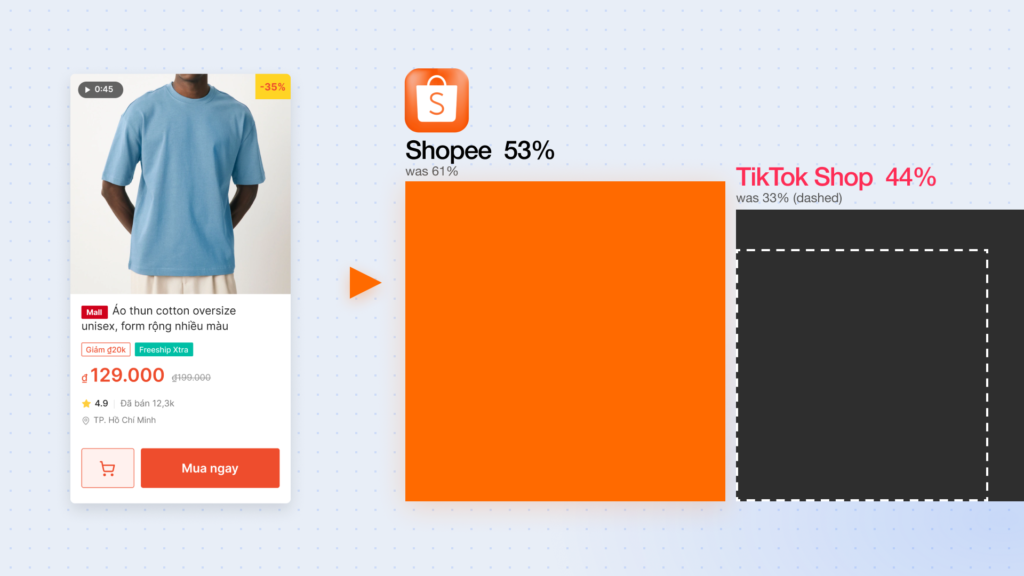
Figure 4. Share of combined GMV on Vietnam’s top four e-commerce platforms, May 2025 – Apr 2026: TikTok Shop 44% (from 33%), Shopee 53% (from 61%). Source: Q&Me via The Investor.
This growth demonstrates that short-form videos and livestreams are no longer just supporting formats for brand communication. They are becoming integral to the commerce experience.
What should brands do?
- Define clear roles for each channel, including social media, e-commerce marketplaces, and owned platforms.
- Develop video and livestream content with clear revenue objectives.
- Create platform-specific strategies covering products, pricing, inventory, and promotions.
- Measure content performance through revenue, conversion rates, and ROAS.
As Social Commerce continues to evolve, brands need to view content not only as a tool for engagement but also as an essential part of the purchasing journey.
5. Al Search expands the SEO Landscape, making brand visibility beyond websites essential
Search behavior is evolving as consumers become increasingly comfortable asking AI-powered tools such as ChatGPT, Gemini, and Perplexity to find information, compare options, and evaluate products.
According to a McKinsey survey of 1,927 consumers, 50% of respondents had used AI-powered search, while 44% considered it one of their primary search sources.
This shift is also affecting website traffic. A Pew Research Center study of 900 US adults found that users clicked on traditional search results in only 8% of visits when Google displayed an AI Summary, compared with 15% when no AI Summary appeared.
Notably, brand websites account for only around 5-10% of sources cited by AI Search, according to McKinsey’s research. This suggests that appearing in AI-generated answers depends not only on website content but also on a brand’s presence across third-party sources, including review platforms, user-generated content and industry websites.
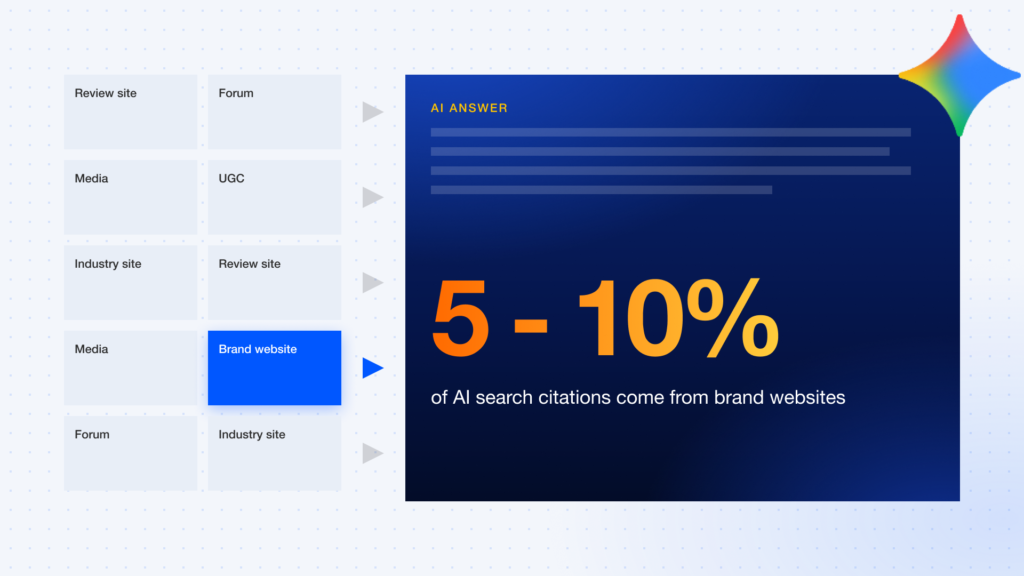
Figure 5. Brand websites make up only about 5–10% of the sources cited by AI search. Sources: McKinsey; Pew Research Center.
What should brands do?
- Expand traditional SEO efforts into GEO (Generative Engine Optimization), focusing on improving brand visibility and the likelihood of being referenced by AI tools.
- Develop content that directly answers the questions customers commonly ask.
- Strengthen brand presence across credible sources such as media outlets, industry websites and review platforms.
- Monitor how frequently the brand is mentioned and featured in AI-generated responses.
As AI-powered search continues to grow, maintaining strong Google rankings remains important. However, brands must also build credibility and visibility across a wider range of information sources.
Social & Content strategies brands should prioritize in 2027
These five trends highlight how Social & Content is evolving toward a more integrated approach, bringing together technology, data, content, and business objectives.
To prepare for 2027, brands should focus on five strategic priorities:
- Establish clear AI usage guidelines: Accelerate content production while maintaining brand voice and identity.
- Prioritize short-form video and personalization: Develop content tailored to different platforms, audience segments, and funnel objectives.
- Build long-term creator partnerships: Focus on relevance, trust, and cumulative performance rather than one-off exposure.
- Connect social media with revenue: Position video and livestream content as integral components of Social Commerce strategies.
- Expand visibility across AI Search: Combine SEO, GEO, PR, and third-party content to improve brand discoverability.
The key is not to chase every emerging trend, but to identify the right opportunities based on business objectives, available resources, and customer behavior.
As AI makes content production increasingly accessible, a clear strategy, distinctive perspectives, and effective execution will be what set brands apart.
REFERENCES
The statistics and insights in this article are drawn from the following industry reports and research. Some findings are based on global or US-specific surveys and should not be interpreted as fully representative of Vietnamese consumers.
- HubSpot – 2026 State of Marketing: Data from 1,500+ Global Marketers
https://blog.hubspot.com/marketing/hubspot-blog-marketing-industry-trends-report - Think with Google – From Attention to Action: Creator-led Growth on YouTube
https://business.google.com/aunz/think/search-and-video/youtube-creator-marketing-creator-led-growth/ - The Investor – TikTok Shop Narrows Gap with Shopee as Vietnam E-commerce Becomes Duopoly
https://theinvestor.vn/tiktok-shop-narrows-gap-with-shopee-as-vietnam-e-commerce-becomes-duopoly-d19240.html - McKinsey – New Front Door to the Internet: Winning in the Age of AI Search
https://www.mckinsey.com/capabilities/growth-marketing-and-sales/our-insights/new-front-door-to-the-internet-winning-in-the-age-of-ai-search - Pew Research Center – Google Users Are Less Likely to Click on Links When an AI Summary Appears
https://www.pewresearch.org/short-reads/2025/07/21/google-users-are-less-likely-to-click-on-links-when-an-ai-summary-appears-in-the-results/
Want this applied to your brand?
Tell us the problem. We come back with a point of view, a scope and a number — usually within two working days.