ChatGPT Ads in Vietnam: Should Brands Test Now or Wait?
ChatGPT Ads in Vietnam became a reality on September 23, 2026, just as many brands were finalizing their 2027 media plans. Since then, one question has come up more than any other: should we start running ads now?
Key takeaways
- ChatGPT Ads launched in Vietnam on September 23, 2026, with self-service buying available to eligible businesses through ChatGPT Ads Manager.
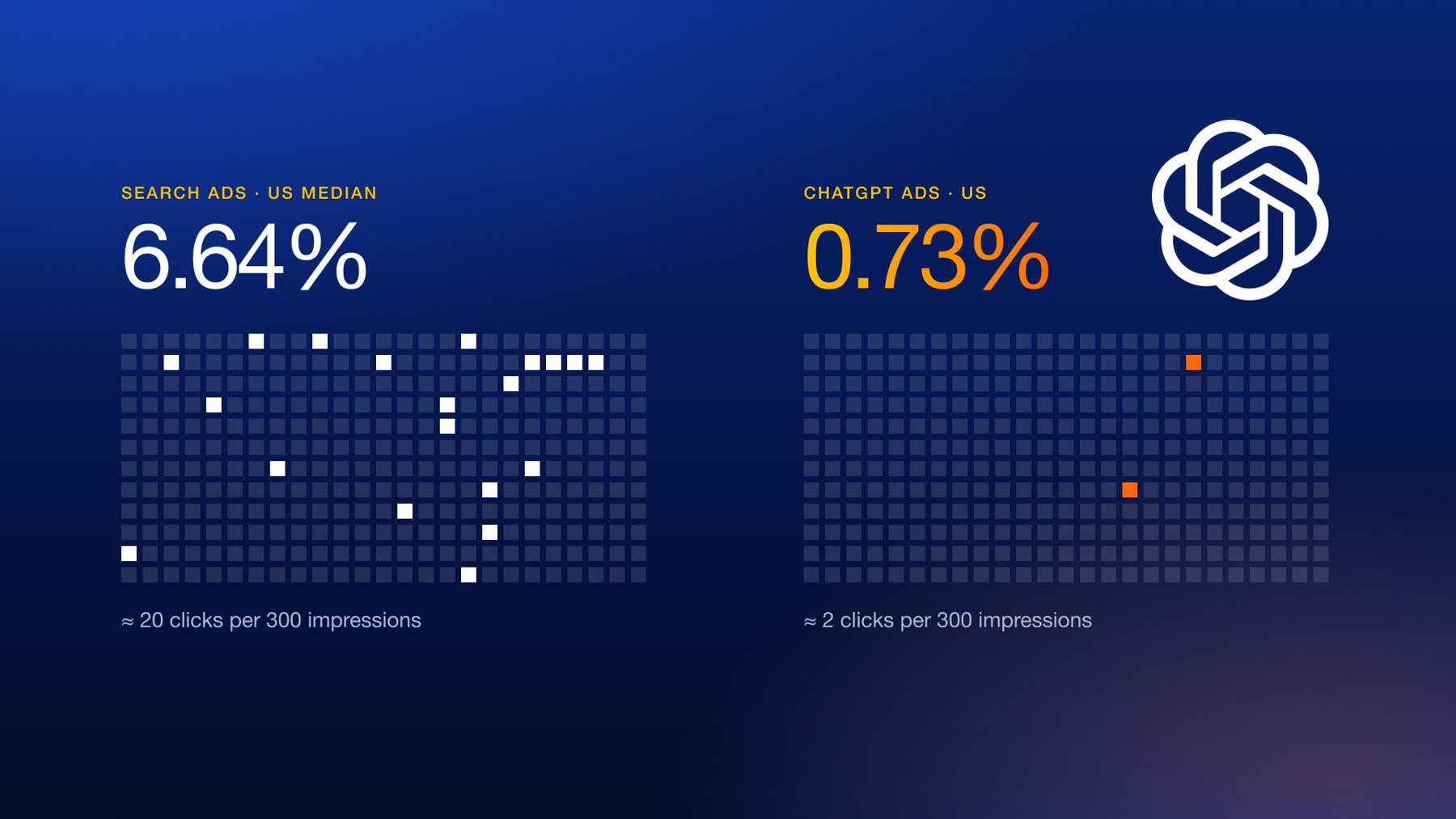
- US ChatGPT Ads recorded a 0.73% cumulative CTR, roughly nine times lower than the 6.64% search median. Different measurement methods and user intent make this a directional comparison, not a measure of relative ROI.
- Critical data remains limited, particularly Vietnam-specific pricing, conversion performance and incrementality.
- Our recommendation: prepare now, test with a controlled experimental budget, and scale only when business results justify additional investment.
The answer is not straightforward. The platform is expanding rapidly, but performance data remains limited. In the US, ChatGPT Ads recorded a cumulative 0.73% click-through rate (CTR), compared with a 6.64% median for Google and Microsoft Search. That gap is significant, although the two channels serve different user behaviors and cannot be judged on CTR alone. Vietnam-specific performance benchmarks are not yet available.
In this article, we examine what has launched, what the first numbers from Graphite and Similarweb actually reveal, and how brands can approach advertising on ChatGPT without making premature budget decisions.
What Launched: ChatGPT Ads Arrive in Vietnam
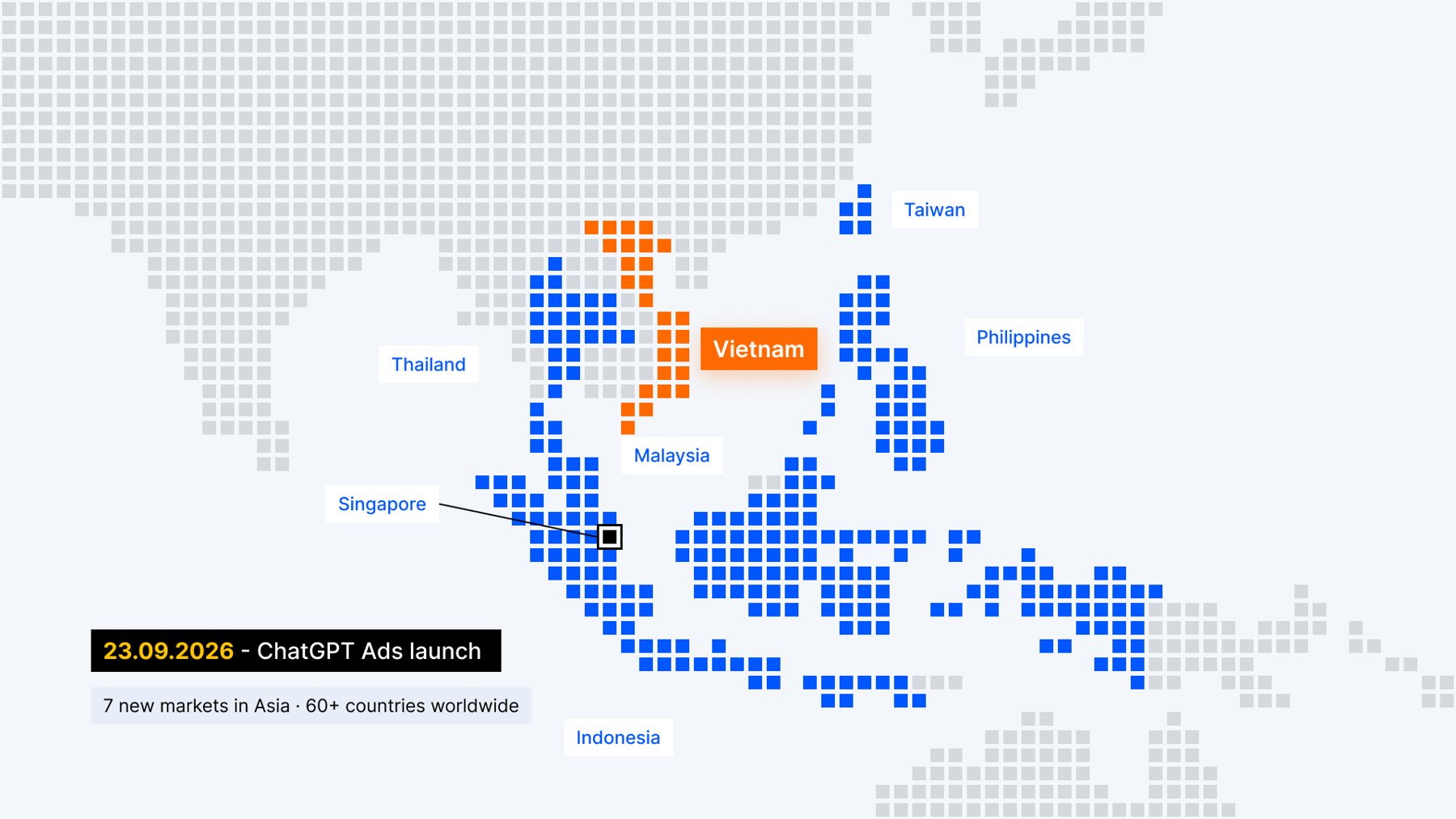
On September 23, 2026, OpenAI began rolling out ChatGPT Ads in seven Asian markets: Vietnam, Singapore, Indonesia, Malaysia, the Philippines, Thailand and Taiwan. With this expansion, ChatGPT Ads became available in more than 60 countries.
The scale behind the launch is significant. According to figures cited in OpenAI’s announcement, ChatGPT Ads reached US$1 billion in annualized revenue in under 200 days, while ChatGPT reaches approximately 1.2 billion people each week. These figures highlight the platform’s reach and commercial momentum, although total ChatGPT usage should not be interpreted as the number of users eligible to see advertising.
Who sees the ads
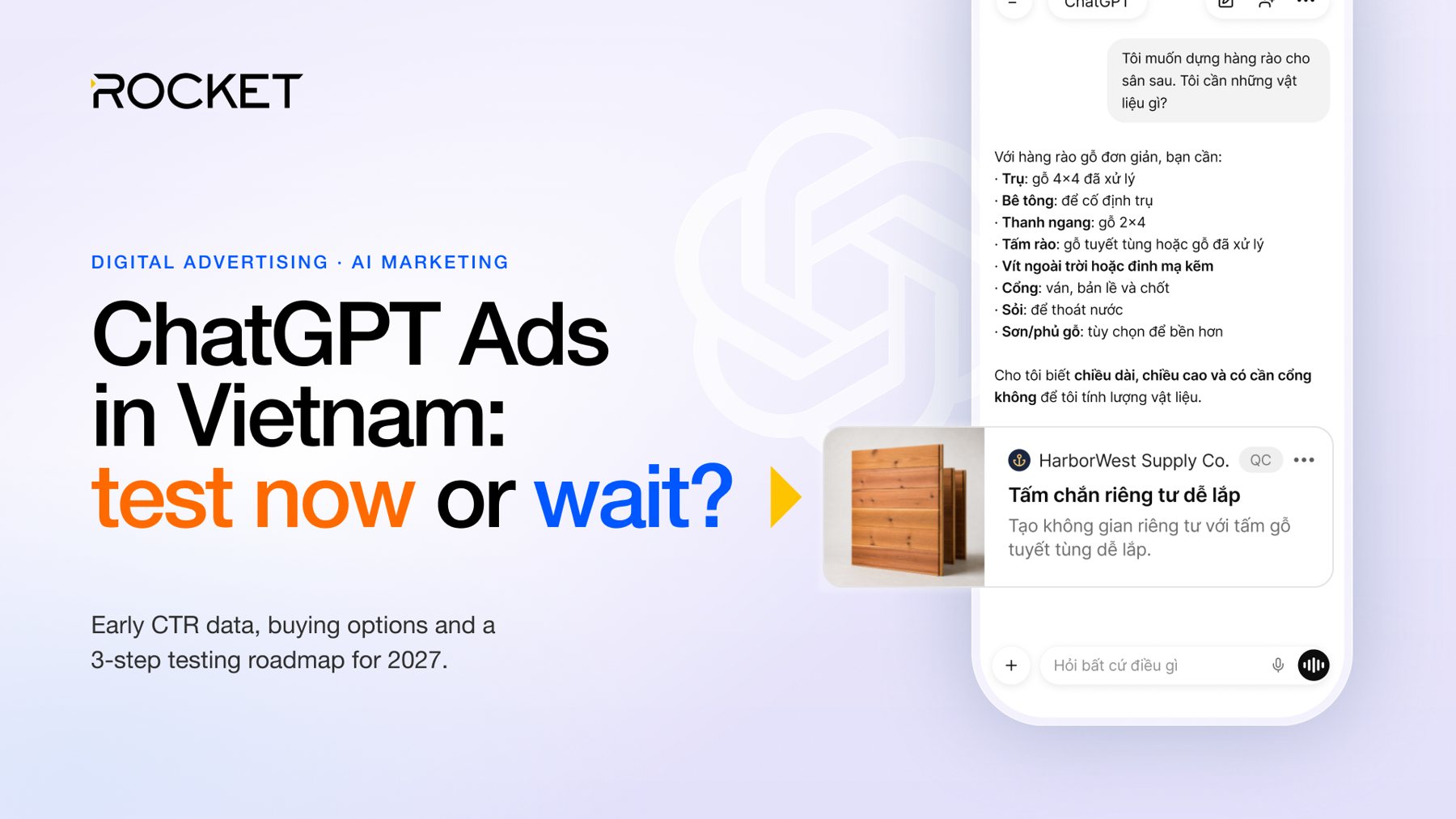
ChatGPT Ads appear on eligible Free and Go accounts. Plus, Pro, Business, Enterprise and Edu plans do not display ads, and eligible Free users may also have an ads-free option with reduced usage limits.
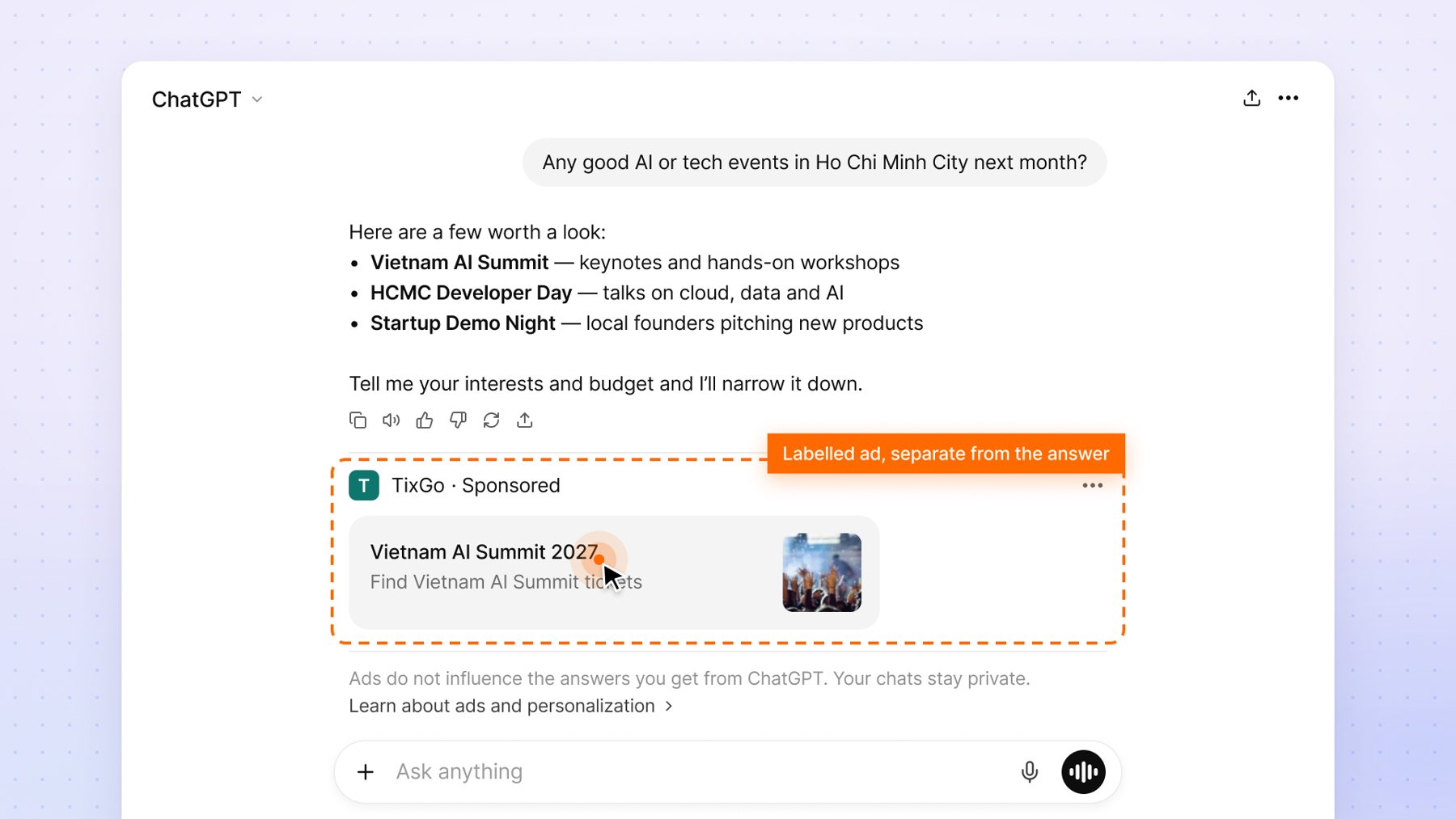
Advertisements appear as clearly labeled placements separate from ChatGPT’s responses. This distinction matters: the advertising format introduces a commercial message into the conversational experience without making it part of the AI-generated answer.
How brands can buy ChatGPT ads
Businesses have three potential routes:
- ChatGPT Ads Manager: self-service campaign setup for eligible advertisers, subject to local account and business requirements.
- OpenAI’s Ads Solutions team: direct engagement with OpenAI for advertising opportunities.
- Agencies and technology partners: support through participating agency networks and advertising partners.
OpenAI identified Dentsu, Havas Media, Omnicom Media, Publicis Groupe and WPP among its agency partners, with Shopee named as a strategic partner in the region.
The buying model has evolved considerably since the US pilot in February 2026, when advertisers reportedly faced a US$200,000 minimum commitment at a US$60 CPM. Subsequent changes introduced lower entry requirements and self-service capabilities, making the platform more accessible.
For brands in Vietnam, the practical implication is that ChatGPT Ads are no longer exclusively an opportunity for advertisers with large pilot budgets. However, local pricing, billing arrangements, minimum spend requirements and available campaign features should be confirmed before committing funds.
ChatGPT Ads CTR: How the First Data Compares
The first substantial performance data comes from The State of ChatGPT Ads, published by Graphite and Similarweb on September 28, 2026. The research analyzes more than 98,000 ads from over 500 US advertisers, offering an early view of adoption and engagement.
Its headline finding is a cumulative US ChatGPT Ads CTR of 0.73% as of September 16, 2026. The reported median for Google and Microsoft Search, based on a separate dataset of 13,474 US campaigns, was 6.64% — approximately nine times higher.
Why ChatGPT Ads should not be judged like search
On Google, users often enter queries with a clear intention to visit a website, compare products or make a purchase. On ChatGPT, users may receive the information they need directly within a conversation. An advertisement must therefore offer a compelling reason to leave that experience.
This difference helps explain why CTR alone is an incomplete measure of performance. A lower click-through rate does not necessarily indicate a less valuable advertising channel. What matters is whether the clicks generate qualified conversions and incremental business value at an acceptable cost.
The early data also shows signs of changing engagement. According to the Graphite and Similarweb report, global ChatGPT Ads CTR increased 112% from late March to September 2026, although this growth came from a low starting point.
Newer markets reported higher initial engagement. Brazil reached a 1.91% CTR and Mexico 1.55%, but each had only about one month of data, compared with more than five months in the US. Differences in campaign mix, audience behavior and observation periods make direct comparisons difficult.
Vietnam entered the market in late September, so brands should be particularly cautious about using early results as a forecast for 2027. Strong initial engagement may be encouraging, but it needs to persist and translate into measurable business outcomes before influencing long-term budget allocation.
Who Is Advertising on ChatGPT, and What Early Patterns Suggest
Software companies have been prominent among early ChatGPT advertisers. According to the Graphite and Similarweb research, B2B SaaS accounted for 19.9% of US impressions, making it the largest category represented in the dataset.
The advertiser rankings also changed substantially over time. Zapier, SAP and The Wall Street Journal reportedly moved out of the top 100 within a few months, while Jotform and Resume.io remained among the top 10 for all 20 weeks examined.
Both Jotform and Resume.io offer products closely connected to tasks users may already discuss with ChatGPT, such as creating forms or preparing résumés. Their continued presence suggests a potentially relevant product–conversation fit, although impression share and advertiser consistency do not establish superior conversion performance.
The first questions in a conversation matter most
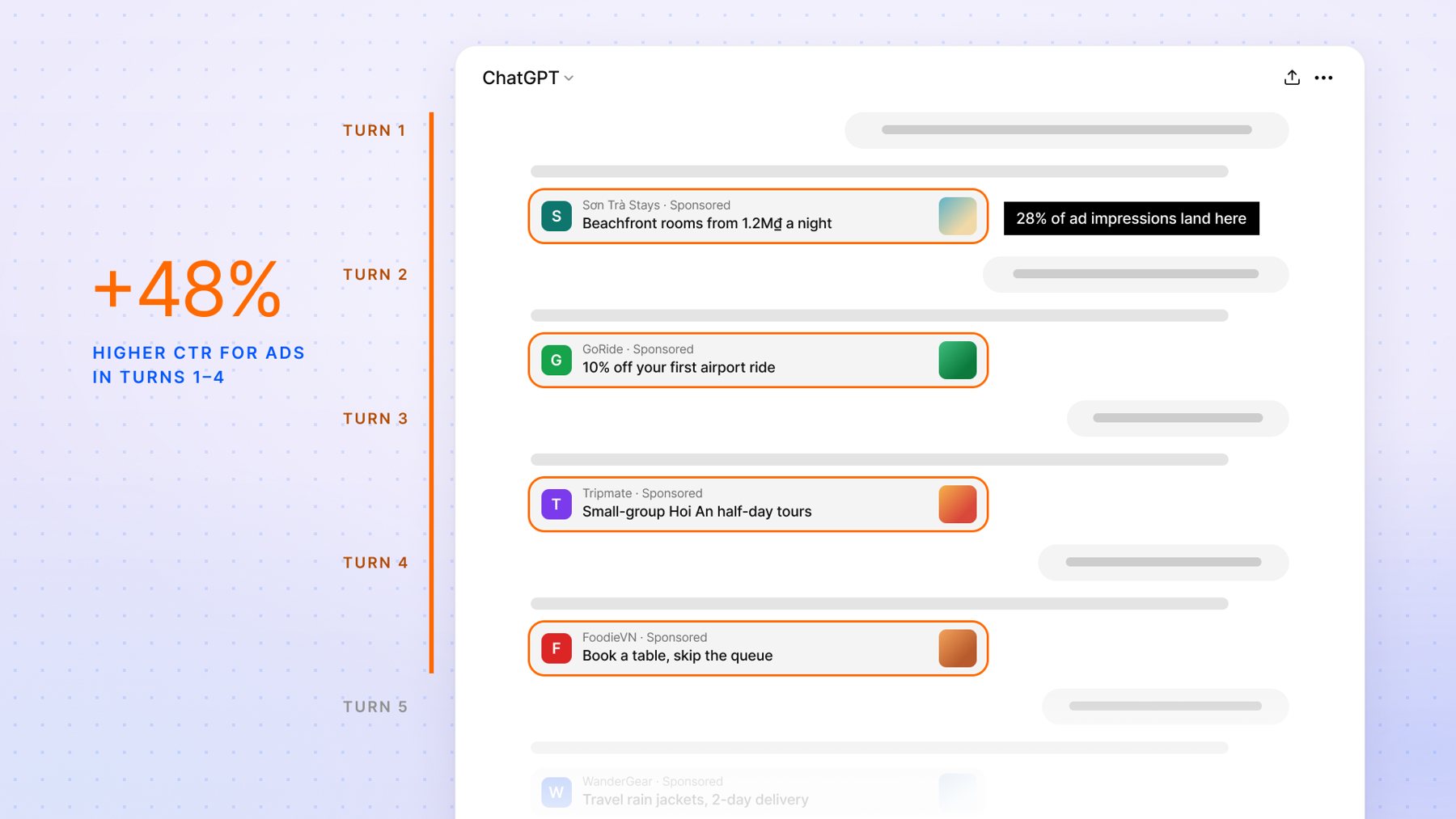
The study found that ads appearing within the first four conversational turns recorded CTRs 48% higher than those appearing later, while the first turn accounted for 28% of impressions. This suggests that conversational context and timing may influence engagement.
Brand awareness may also play a role. Brand names appeared in 61% of conversations containing ads, compared with 36% of conversations without ads. The researchers identified these findings as preliminary, and the association should not be interpreted as proof that advertising caused greater brand awareness.
OpenAI has also shared encouraging outcomes from selected US advertisers. WeightWatchers reported a 15.3% lower cost per conversion than its paid search average, while Portland Leather reported that 93% of visitors arriving through ChatGPT ads were new customers.
These examples demonstrate what individual campaigns may achieve, but they are advertiser-reported results rather than representative benchmarks. Their relevance to Vietnam will depend on local audiences, campaign economics and the availability of comparable advertising capabilities.
What the Data Doesn’t Tell Us Yet
Despite the growing body of early research, several questions remain unanswered for brands evaluating ChatGPT Ads in Vietnam.
- Advertising costs: the Graphite and Similarweb study does not provide a comprehensive dataset of CPM, CPC or advertiser spending.
- Conversion performance: representative conversion rates, revenue contribution and return on ad spend remain unavailable.
- Incrementality: it is unclear how much additional demand ChatGPT Ads create, rather than capturing customers who might otherwise convert through search or another channel.
- Vietnam benchmarks: reliable local CTR, pricing and conversion benchmarks have not yet been established.
- Research limitations: Similarweb and Graphite operate commercially in adjacent analytics and marketing services, making methodology and independent validation important when interpreting their findings.
These limitations are particularly relevant when comparing ChatGPT Ads with established channels. Search campaigns often have years of historical performance data, mature measurement systems and predictable optimization practices. ChatGPT advertising is still developing its commercial and measurement infrastructure.
There are also category-specific considerations. Advertisers in regulated sectors, including healthcare and financial services, should verify current content restrictions and placement eligibility before planning campaigns. Policies governing sensitive topics may affect the inventory and targeting opportunities available.
For now, the evidence supports treating ChatGPT Ads as a complementary channel to investigate, rather than a proven substitute for search advertising.
A 3-Step Roadmap for Testing ChatGPT Ads in Your 2027 Media Plan
For brands considering advertising on ChatGPT, Rocket Group recommends a structured testing approach. The goal is not simply to enter the platform early, but to gather evidence that can support better media investment decisions.
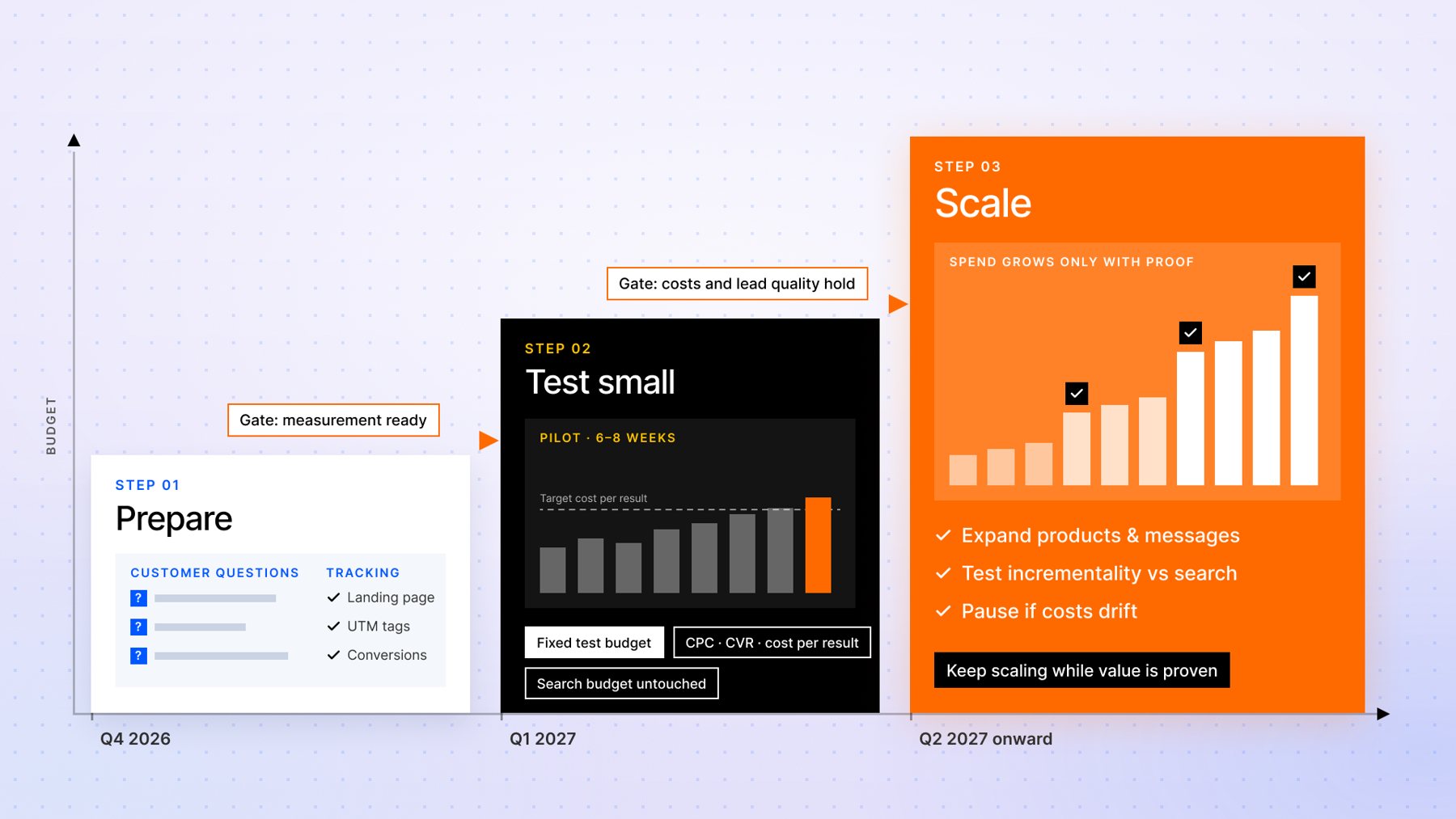
Q4 2026
Prepare
Goal: understand customer intent and establish the foundations for measurement before committing significant spend.
- Confirm advertising eligibility, available campaign formats and buying requirements in Vietnam.
- Identify 20–30 common questions customers ask when researching products or services in your category.
- Review how ChatGPT addresses those needs and which brands or solutions appear in relevant conversations.
- Prepare suitable landing pages, UTM parameters and conversion tracking.
Move forward whenat least one meaningful customer-need category aligns with your offering, the available advertising format supports the intended campaign, and conversion measurement is ready.
Q1 2027
Test Small
Goal: evaluate one product or service through a controlled six-to-eight-week pilot, with a fixed budget and clearly defined success metrics.
- Allocate funds from an experimental budget rather than immediately reducing proven search investment.
- Develop advertising messages specifically for the available ChatGPT format and Vietnamese audience.
- Monitor CTR and CPC where available, alongside conversion rate, cost per qualified result and lead quality.
- Compare results with relevant existing campaigns, accounting for differences in audience intent and attribution.
Move forward whenthe pilot produces sufficient data to demonstrate acceptable acquisition costs, qualified conversions and reasonably consistent performance. The required testing period should depend on conversion volume rather than a fixed six-week threshold.
From Q2 2027
Scale
Goal: determine whether ChatGPT Ads deserve a larger, sustained allocation within the media plan.
- Expand into additional products or message variations where the platform supports them.
- Evaluate conversion quality, customer acquisition cost and revenue contribution.
- Test whether ChatGPT Ads generate incremental demand rather than simply shifting conversions from search.
- Increase investment gradually, with performance checkpoints and clear conditions for reducing or pausing spend.
Continue scaling whenthe channel delivers measurable business value at an acceptable cost and demonstrates a meaningful contribution to overall marketing performance.
Throughout the process, brands should protect budgets allocated to campaigns that are already delivering proven results. A new platform deserves investment when it earns that investment through evidence, not simply because competitors have begun advertising there.
Frequently Asked Questions About ChatGPT Ads in Vietnam
Are ChatGPT Ads available in Vietnam?
Yes. OpenAI announced the expansion of ChatGPT Ads into Vietnam on September 23, 2026, alongside Singapore, Indonesia, Malaysia, the Philippines, Thailand and Taiwan.
Who sees ads on ChatGPT?
Ads are shown to eligible users on the Free and Go plans. Plus, Pro, Business, Enterprise and Edu plans are ad-free, and an ads-free Free option with reduced usage limits may also be available.
How can brands in Vietnam buy ChatGPT ads?
Eligible advertisers can explore self-service buying through ChatGPT Ads Manager, direct engagement with OpenAI’s Ads Solutions team, or participating agency and technology partners. Access and requirements should be confirmed for the relevant business entity.
Is there a minimum budget for ChatGPT Ads in Vietnam?
The platform has moved beyond the US$200,000 minimum commitment associated with its early pilot. However, advertisers should confirm current minimum spend, pricing and billing requirements for Vietnam before finalizing a campaign budget.
What CTR can brands expect from ChatGPT Ads?
Graphite and Similarweb reported a cumulative US CTR of 0.73% as of September 16, 2026. This is not a Vietnam benchmark, and actual performance will depend on the audience, campaign, creative and measurement period.
Should ChatGPT Ads replace search budget?
Not on the available evidence. Brands should initially approach ChatGPT Ads as a complementary experimental channel and consider reallocating established budgets only when their own conversion, acquisition cost and incrementality results support that decision.
Planning your 2027 media strategy? Rocket Group can help assess whether ChatGPT Ads fit your customer journey, identify suitable testing opportunities and build a measurement framework before you commit a budget.
Sources
- The State of ChatGPT Ads — Graphite and Similarweb, September 28, 2026
- ChatGPT Ads Expands to Southeast Asia and Taiwan — OpenAI, September 23, 2026
- ChatGPT Ads Expands into Southeast Asia and Taiwan — TNGlobal, September 24, 2026
- OpenAI Gains 7 Asian Markets for ChatGPT Ads, Passing 60 Countries — PPC Land, September 2026
- ChatGPT Ad Click Rate Gains 112% Worldwide, Similarweb and Graphite Find — PPC Land, September 2026
- What Is a Good CTR? 2026 Benchmarks — AdManage.ai, updated October 31, 2026
- ChatGPT Ads vs. Google Search Ads: 5 Differences — HubSpot, updated October 29, 2026
Want this applied to your brand?
Tell us the problem. We come back with a point of view, a scope and a number — usually within two working days.